
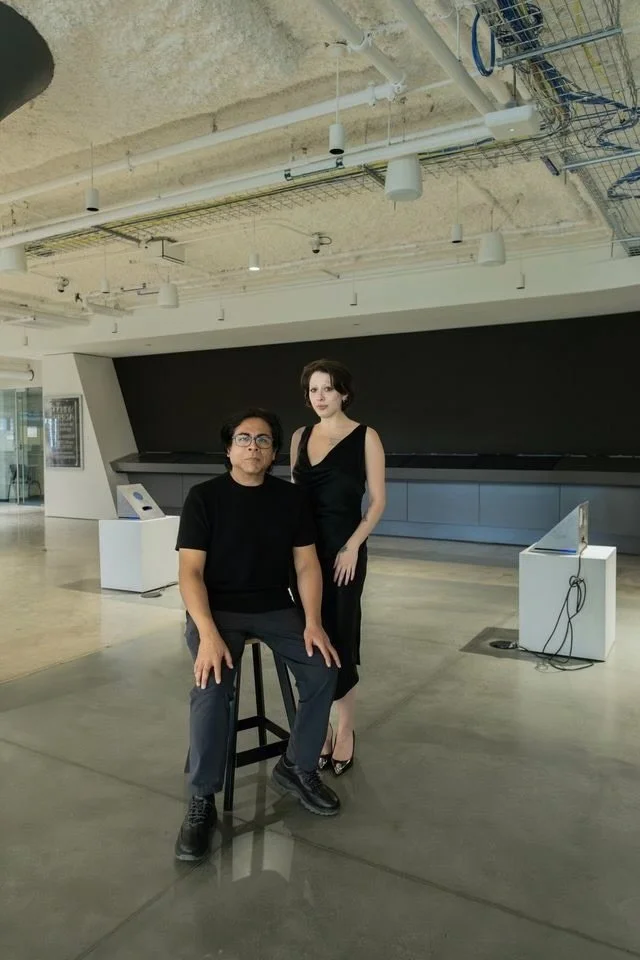
Technoterria - Collaborative Exhibition
Georgia Tech - Interactive Media Zone
Atlanta, GA - 2025/Jan 2026
TW Pilar - Pilar studios\Ivan Reyes
Technoterria: Systems, Labor, and Speculative Industrial Futures
Created by the combined disciplines of T.W. Pilar, an independent researcher & sculptural designer, and Ivan Reyes, a creative technologist & digital artist Abstract
Technoterria is a speculative retrospective exhibition developed by Pilar Studios in collaboration with Ivan Reyes and presented at the Georgia Tech Library Interactive Media Zone between March 2025 and January 2026. Situated within a leading technological research institution, the exhibition presents a projected one-hundred-year timeline of plausible industrial, technological, and socio-economic developments extrapolated from contemporary research and AI-assisted forecasting. Framed as a future society’s reflection on its own technological lineage, Technoterria examines how systems of labor, energy, entertainment, governance, and ecological management evolve not through rupture, but through incremental normalization. The exhibition operates as a materialized timeline—tracing how familiar industrial logics persist, adapt, and aestheticize themselves across decades until they are no longer perceived as systems, but as environmental conditions. Through immersive world-building, speculative graphic systems, participatory activations, and institutional-scale technological interfaces, Technoterria presents artifacts, infrastructures, and cultural mechanisms as if they were already historical. Pilar Studios’ philosophical framework of Second Nature functions throughout the exhibition as an interpretive condition rather than a constructed thesis. The works do not seek to define Second Nature, but to render its consequences visible: environments in which industry, technology, ecology, and human participation have become indistinguishable- experienced not as ideology, but as lived reality. In this way, Technoterria positions the viewer inside a future archive of the present, revealing how technological progress, labor, and nostalgia quietly converge into the environments societies come to accept as natural. Institutional Context and Technological Mediation
The presentation of Technoterria within the Georgia Tech Library Interactive Media Zone is a deliberate and conceptually operative decision. The IMZ functions as a technologically advanced public interface- equipped with large-scale digital display systems, interactive media infrastructure, and open-access spatial conditions- positioning the exhibition within an environment already dedicated to experimentation, innovation, and applied research. By situating a speculative, retrospective narrative inside a leading technological institution, Technoterria collapses temporal distance between prediction and production. The exhibition unfolds within a space occupied daily by students training in the very fields- engineering, computation, design, and systems thinking- that underpin the futures it speculates upon. In this context, the exhibition is not merely observed; it is encountered as a plausible outcome of existing trajectories. Technological mediation within Technoterria therefore operates on two levels: as an internal system within the exhibition’s world-building, and as an external condition provided by the institution itself. Screens function simultaneously as narrative devices, authoritative system voices, and infrastructural mirrors of the surrounding academic environment. The result is a feedback loop in which speculative futures are presented inside the institutional frameworks capable of realizing them- rendering the exhibition less a warning or fantasy, and more a provisional historical record of what emerges when technological ambition, labor systems, and institutional power align. Throughout this context, Pilar Studios’ philosophical framework of Second Nature operates as an interpretive lens rather than a constructed thesis. The exhibition does not argue for Second Nature; it demonstrates its consequences. Industry, technology, ecology, and human participation appear as a single, continuous environment- experienced not as ideology, but as lived reality. In this way, Technoterria positions the viewer inside a future archive of the present, revealing how technological progress, labor, and nostalgia quietly converge into the environments societies come to accept as natural. I. Authorship, Collaboration, and Exhibition Formation
Technoterria was developed through a close collaboration between Pilar T.W. and Ivan Reyes, whose complementary practices shaped the exhibition as both a philosophical system and a functional world. Pilar T.W., working through Pilar Studios, brings a research-driven artistic practice grounded in the philosophical framework of Second Nature, which examines the entanglement of human industry, ecological systems, and perceptual environments. Her role within Technoterria centered on conceptual authorship, world-building logic, aesthetic direction, and the integration of long term philosophical inquiry into material and spatial form. Pilar’s approach positions exhibitions as operational systems- where objects, interfaces, and participation function as evidence of broader environmental and ethical conditions. Ivan Reyes contributed expertise in technological design, systems implementation, and fabrication strategy, translating speculative concepts into functional, interactive infrastructures. His role focused on the realization of the exhibition’s technical components, including system architecture, activation logic, and the integration of hardware and digital interfaces within the physical environment. Reyes’ practice emphasizes usability, clarity, and execution- ensuring that speculative systems operate convincingly as real-world mechanisms rather than symbolic gestures. The development of Technoterria required extensive use of multiple artificial intelligence engines, software platforms, and iterative workflows across image, video, and system design. These tools were employed not as autonomous authors, but as collaborative instruments supporting rapid prototyping, aesthetic refinement, and performance testing across overlapping programs and formats. Outputs were repeatedly translated, recombined, and adjusted to meet the exhibition’s conceptual and technical specifications. This AI-assisted process was integral to the exhibition’s formation and was carried out using open-source and publicly accessible technologies, situating the methodology within the same technological landscape available to the broader public. The use of AI in Technoterria therefore reflects the exhibition’s core premise: that emerging technological systems are not distant or proprietary abstractions, but present-day conditions shaping creative labor, perception, and production. The collaboration between Pilar T.W. and Ivan Reyes was structured around an iterative process of co-development, in which conceptual propositions, technological mediation, and material feasibility informed one another continuously. Rather than separating theory from execution, Technoterria was built through reciprocal exchange: philosophical frameworks shaped system design, while technological constraints refined conceptual outcomes. Authorship within Technoterria is therefore distributed rather than singular. The exhibition reflects a shared commitment to constructing systems that are internally coherent, materially plausible, and experientially grounded- where ideas are not illustrated, but enacted through collaboration, infrastructure, and participation. - Primary System Components: Digital Timeline and Interactive Gaming Consoles
At the foundation of Technoterria are two interdependent system structures that organize the exhibition’s narrative, participation, and experiential logic. These systems operate together to construct the exhibition as a functioning environment rather than a representational display linking speculative history with embodied engagement. • The Digital Timeline The digital timeline functions as the exhibition’s central narrative and archival framework. Presented through large-scale digital interfaces, it organizes Technoterria’s speculative one-hundred-year retrospective by outlining plausible technological, industrial, and socio-cultural developments extrapolated from contemporary research and AI-assisted forecasting. Rather than operating as didactic explanation, the timeline adopts the visual and rhetorical language of institutional history, corporate record, and authoritative archive. Its role is to normalize speculation by presenting projected futures as settled historical fact- absorbed into cultural memory and stripped of contingency. • Interactive Direct Gaming Consoles The interactive direct gaming consoles translate the exhibition’s abstract systems into physical experience. These consoles require bodily participation and exertion, embedding labor directly into engagement under the guise of recreation or cultural activity. Operating through constraint, repetition, and endurance rather than open-ended play, the consoles foreground the relationship between energy expenditure and system maintenance. Participation sustains the system without granting control over it, revealing how labor is often aestheticized, normalized, and disguised within technologically mediated environments. Together, these systems collapse the distinction between information and action. The timeline legitimizes the consoles as historical artifacts within the exhibition’s speculative future, while the consoles enact the labor conditions that sustain the systems described by the timeline. In combination, they ensure that Technoterria is not only viewed as a constructed world, but experienced as a functioning system- one that relies on continuous participation to persist. II. World-Building as Retrospective Method
In Technoterria, world-building functions as a retrospective method rather than a speculative exercise. The exhibition is constructed from the position of an imagined future looking backward, treating the early twenty-first century as a historical threshold whose technological and industrial assumptions have already crystallized into environmental norms. This temporal inversion allows the exhibition to present its systems as inheritance rather than projection. The digital timeline and interactive gaming consoles are framed as historical artifacts within a coherent continuum, each derived from plausible extensions of existing research trajectories, labor models, energy infrastructures, and computational logics. AI-assisted forecasting and iterative design are employed not to invent speculative novelty, but to test plausibility- mapping how present-day systems accumulate, normalize, and persist across time. World-building within Technoterria is achieved through systemic coherence rather than narrative spectacle. Graphic languages, interface structures, material decisions, and spatial organization operate as infrastructural cues, signaling authority, usability, and continuity. These elements encourage the exhibition to be encountered as an operational environment- one that appears already inhabited, maintained, and trusted. Framed retrospectively, nostalgia becomes an organizing force rather than an emotional byproduct. Systems of labor, entertainment, and technological mediation are presented as cultural inheritances- maintained through repetition rather than questioned through critique. This perspective reveals how legitimacy is often produced not through ethical resolution, but through historical framing: provisional systems become customary; contested mechanisms become environmental conditions. By collapsing the distinction between object and environment, Technoterria positions participation as maintenance rather than revelation. Engagement sustains the system without offering narrative closure or control, mirroring the infrastructural dependencies of contemporary technological life. The exhibition thus functions as a future archive of the present- one that renders visible how today’s systems, once historicized, become the conditions societies come to accept as inevitable. III. The Constructed World: Post-Labor Systems, Aesthetics, and Lore
The world of Technoterria is situated in the year 2125 and is presented as a fully realized post labor society. Within this environment, traditional human labor has not been reorganized or displaced-it has been rendered obsolete. The operational weight of production, maintenance, governance, and logistics is carried almost entirely by advanced technological systems, including artificial intelligence, automated infrastructures, and self-regulating networks. Human survival, productivity, and societal continuity no longer depend on work. In place of government-based civic structures, this society is organized through a dominant technological megacorporation that functions simultaneously as infrastructural operator, cultural authority, and historical steward. Rather than governing through policy or law, this system governs through design- shaping behavior, meaning, and participation via platforms, interfaces, and entertainment systems. Its primary cultural output is gaming, understood not simply as diversion, but as a structuring mechanism for leisure, stimulation, and identity within a world no longer organized by necessity. Lore within Technoterria is embedded rather than narrated. The exhibition’s digital timeline functions as a historical apparatus that traces the society’s evolution through pivotal technological shifts, with particular reverence afforded to the year 2025- positioned as a catalytic moment when converging advances in artificial intelligence, automation, and computational systems initiated a rapid acceleration toward post-labor conditions. These developments are framed as foundational achievements: the moment humanity decisively transferred labor, governance, and optimization to machines in pursuit of efficiency, stability, and progress. Over time, these achievements become canonized. The absence of labor is historicized as triumph, and technological governance is normalized as environmental condition rather than political structure. Yet embedded within this celebration is a growing cultural stagnation. As systems mature and human effort is increasingly removed from consequence, society enters a prolonged state of surplus leisure. In revisiting historical records of labor- initially as curiosity, then as entertainment- humankind rediscovers the psychological resonance of effort, resistance, and reward. What begins as nostalgic engagement evolves into quiet discontent, reactivating a desire for embodied meaning and producing resentment toward the very systems that eliminated necessity. The constructed world of Technoterria does not dramatize collapse, rebellion, or revolution. Instead, it depicts a society slowly circling its own history- reverent of its innovations, exhausted by their consequences, and increasingly drawn to the conditions it once defined as obsolete. This tension is not resolved within the world; it is stabilized as cultural equilibrium. This world- its logic, lore, and aesthetic coherence- was the first and most critical milestone reached by T.W. Pilar and Ivan Reyes through weeks of sustained collaboration and speculative ideation. Before any physical exhibition design, sculptural fabrication, graphic systems, or technological implementation were considered, the artists committed to fully articulating the internal reality of Technoterria: how it functions, what it values, and how it understands itself. The exhibition did not emerge as an illustration of theory, but as a direct material consequence of this world-building process. Technoterria was born not from objects or interfaces, but from the construction of a believable future environment- one coherent enough to necessitate its own physical manifestation. IV. Technological Mediation and Material Realization
With the internal logic of Technoterria established through world-building, the exhibition’s development shifted toward material translation- how a speculative post-labor society could be rendered legible, credible, and operational within physical space. Technological mediation became the primary mechanism through which the constructed world of 2125 was externalized, bridging narrative coherence with embodied experience. The realization of the exhibition unfolded through layered workflows of digital production, media extraction, and physical fabrication, in which AI systems, software platforms, and iterative design processes were used to generate and refine visual environments, graphic systems, temporal sequences, and interface behaviors. These outputs were treated not as final artifacts, but as provisional material repeatedly translated across formats until they aligned with the exhibition’s conceptual, aesthetic, and performative requirements. This process emphasized plausibility over spectacle. Visual assets were refined to align with institutional, archival, and infrastructural aesthetics rather than overt futurism. Interfaces prioritized clarity, authority, and continuity, borrowing from the visual language of corporate systems, technological platforms, and historical records. Through repetition and constraint, Technoterria establishes itself as an operational environment rather than a speculative illustration- one that appears already inhabited and normalized. Material realization within the exhibition takes form through two primary expressions: the large scale digital timeline and the TōcōPOD gaming systems. The digital timeline is presented on a monumental screen and integrates narrated milestone videos, animated temporal sequences, static archival graphics, and an interactive slideshow archive that mirrors the informational content of the narrated sequence. A custom-composed score accompanies the instructional timeline milestones, reinforcing their authority as cultural and historical records. Interwoven throughout this system are graphic identities and informational archives associated with the TōcōPODs, situating the gaming systems as preserved artifacts within the exhibition’s internal history. The TōcōPODs themselves are realized as physical steel sculptural consoles, designed as infrastructural objects rather than consumer entertainment devices. Each console houses modular internal systems, including Raspberry Pi units that locally store and operate the games without reliance on network connectivity. Multiple transformers manage power storage, cooling, and sustained operation, while integrated lighting and speakers function both technically and aesthetically. Each console hosts a distinct game- BioSplice, ElectroCity 2, and State of Genesis- each accompanied by a unique soundscape and score that differentiates its internal logic while maintaining coherence within the larger system. The exhibition’s technological mediation operates across scale and space, most notably through its placement within the Georgia Tech Library Interactive Media Zone. The IMZ’s large-scale screen and open public circulation environment were not selected to accommodate a predetermined exhibition format; rather, Technoterria was conceived in direct response to encountering this technological condition. The presence of institutional-scale digital infrastructure within a non-traditional gallery context enabled the exhibition to operate as a fully mediated system-world. Situated within daily academic movement, the exhibition is encountered by students and researchers in engineering, computation, and systems design- the very individuals positioned to realize the futures the exhibition speculates upon- collapsing distance between representation and production. Throughout this process, Technoterria was developed using a wide range of open-access, publicly available, and widely circulating technologies, situating the exhibition’s production within the same technological landscape accessible to the broader public. AI systems were employed for research, forecasting, image and video generation, narrative development, and iterative refinement, including tools developed by OpenAI (ChatGPT, Sora), Anthropic (Claude), and Google (Gemini, Neo3, NanoBanana), alongside platforms such as Midjourney, Kling, Higgsfield, Ollama, Stable Diffusion, Flex.schnell, and ComfyUI, with audio narration supported by ElevenLabs. Media compositing and refinement were carried out using Adobe After Effects, Adobe Photoshop, and Adobe Firefly, while software development and system logic were implemented through Visual Studio, Factory.ai, Cline, and browser-based HTML/JavaScript frameworks. Physical systems and game execution were hosted locally using Raspberry Pi hardware. The intentional use of these tools reinforces Technoterria’s central premise: that the futures it imagines are not distant or proprietary, but assembled from technologies already embedded within contemporary creative, industrial, and computational practice. In this way, technological mediation and material realization function not as illustration, but as evidence- demonstrating how coherent worlds emerge through layered translation, iterative refinement, and systemic design, until a future no longer feels speculative, but present. V. Institutional Embedding and Future Makers
The presentation of Technoterria within the Georgia Tech Library Interactive Media Zone is integral to its meaning. The IMZ is a digitally responsive exhibition environment featuring a more than 40-foot curved landscape screen alongside ten interactive touch stations that support multiple modes of engagement- digital exhibits, presentation/pop-up lecture, and hero mode for campus promotion and storytelling. Located on the Grove Level of Price Gilbert Memorial Library, this space was developed to showcase digital and interactive scholarship across Georgia Tech, bringing together research, creativity, visualization, and technology in a highly visible public space. For Technoterria, the IMZ did more than host content- it enabled the exhibition to operate at institutional scale, structurally and conceptually. Technoterria did not adapt itself to a typical white cube gallery; instead, it was developed through and for this site’s technological capacity, with the IMZ’s screen and touch infrastructure serving as foundational conditions for the work’s narrative and systems logic. The decision to embed the exhibition inside this academic and technological environment was purposeful and generative. Georgia Tech is a public research university whose mission centers on innovation in engineering, computation, systems design, and applied creativity. The IMZ exists to translate that mission into spatial experience, exposing students, faculty, and visitors to dynamic digital work across disciplines. Rather than situating Technoterria in a traditional gallery context- which would have isolated it from the real-world stakes of technological education and research- the artists intentionally chose a locus where future makers live, learn, and work. The collaboration with Georgia Tech transforms Technoterria from a speculative installation into a lived encounter for people who are already situated within the fields shaping our technological trajectory. Students passing through the library do not engage with the exhibition as distant fiction; they encounter Technoterria as a large-scale interactive system embedded in their daily academic rhythms. This placement collapses the boundary between speculation and production: the very individuals whose research could materially contribute to the futures Technoterria narrativizes are exposed to that world in motion, not behind glass. This strategic institutional positioning is also an explicit statement about AI, creativity, and the future of interdisciplinary practice. At a time when artificial intelligence is deeply contested in creative industries- often framed as threat, replacement, or ethical problem- Technoterria leverages that tension productively. Pilar T.W. and Ivan Reyes chose not to present this work within isolation, criticism, or defensive framing, but by inserting it into the heart of an academic community engaged in fields directly shaped by AI and technology. In doing so, the exhibition models a different mode of engagement: one in which creativity and computation are not opposed, but co-constitutive. Rather than resisting technological integration into artistic practice, Technoterria demonstrates that advanced tools can be conceptually productive and ethically interrogated within academic spaces that train the very inventors of emerging systems. The collaboration thus moves beyond exhibition-making into academic discourse, prompting students and researchers to reflect on how systems are designed, normalized, and experienced. It invites them to consider how their own educational trajectories intersect with broader societal infrastructures- turning the IMZ from a display venue into a laboratory for future-making thought. By actively participating in this space, Technoterria offers a counter-narrative to traditional exhibition logics: it replaces passive consumption with situated engagement, transforms spectators into participants in technological imagination, and catalyzes dialogue between artistic speculative systems and real-world innovators navigating AI’s cultural, ethical, and infrastructural implications. VI. TōcōPOD Systems: Technical Construction and Gameplay Implementation
The TōcōPODs are single-user, physically interactive gaming systems developed for Technoterria by Pilar Studios in collaboration with Ivan Reyes. The term TōcōPOD derives from the Greek root tókos, meaning labor or production, and is used here descriptively to denote consoles that require bodily exertion as a core gameplay input. All three TōcōPOD games were developed using a shared software and hardware ecosystem, with variations in physical interface, audiovisual output, and gameplay logic. Each system operates locally, without network dependency, and is housed within a steel sculptural console that integrates computing hardware, power regulation, cooling, audio output, and lighting. Shared Development Environment -
Each TōcōPOD game was created using a combination of the following tools and systems: • AI & Generative Systems: OpenAI (ChatGPT), Anthropic (Claude), Google (Gemini), Midjourney, Stable Diffusion, ComfyUI, Flex.schnell, Higgsfield.ai, Kling • Visual & Motion Tools: Adobe After Effects, Adobe Photoshop, Adobe Firefly • Audio Systems: ElevenLabs (voice generation), custom sound synthesis and composition workflows • Programming & Development: Visual Studio, Factory.ai, Cline, HTML / JavaScript • Hardware & Execution: Raspberry Pi units (local game execution), modular computing components, physical input mechanisms Each game runs independently on local hardware, with bespoke physical inputs mapped to software logic via custom scripts. TōcōPOD Game Systems -
State of Genesis: Core System Focus: Physical manufacturing simulation Primary Interaction: Timed mechanical control and material placement Gameplay Structure: Players physically regulate the speed of a conveyor mechanism to align raw materials beneath a press that converts them into finished products. The system operates in fixed-duration cycles. Performance is measured by output quantity and accuracy within each cycle. Technical Components: • Local execution on Raspberry Pi hardware • Custom HTML/JavaScript game logic • Physical speed-control interface mapped to software timing thresholds • Real-time visual feedback rendered via generative and composited assets • Dedicated audio loop synchronized to production cycles System Characteristics: • Closed-loop, repeatable gameplay • Precision- and timing-based interaction • No persistent progression beyond each completed cycle ElectroCity 2: 徒劳的焚烧:
Core System Focus: Energy generation and balance Primary Interaction: Sustained physical input regulating system thresholds Gameplay Structure: Players physically add fuel to an incineration mechanism to maintain a balance between energy production and environmental tolerance. Insufficient input results in power failure; excessive input results in system overload. The game has no fixed endpoint and continues as long as balance is maintained. Technical Components: • Local execution on Raspberry Pi hardware • Continuous-state logic implemented in HTML/JavaScript • Physical input mechanisms calibrated to dynamic threshold values • Generative visual system responding in real time to input intensity • Audio system modulated by system state (stable, overload, failure) System Characteristics: • Continuous feedback loop • Dual failure conditions • Infinite playability through sustained interaction BioSplice:
Core System Focus: Genetic modification and risk-based optimization Primary Interaction: Precision selection and recombination Gameplay Structure: Players manipulate genetic variables to enhance plant performance while avoiding unstable mutations. Successful combinations yield viable growth; incorrect combinations result in system failure, including crop loss or environmental contamination. Gameplay operates in fixed-duration cycles. Technical Components: • Local execution on Raspberry Pi hardware • Hand-coded rule-based genetic logic • Physical input tools mapped to selection and recombination functions • Generative visual assets representing cellular and plant states • Audio feedback signaling stability, mutation, or failure System Characteristics: • Risk–reward decision structure • Immediate feedback based on player input • Emphasis on precision and restraint Attribution
All TōcōPOD systems were designed and built by Pilar Studios, with visual systems design by Ivan Reyes, and developed in association with the Georgia Tech Library Interactive Media Zone. Each system represents a standalone interactive work built specifically for physical exhibition deployment. VII. Digital Timeline: Ten Eras of Technological Transformation (2025–2125)
The Digital Timeline was technologically developed and implemented by Ivan Reyes, with artistic direction, conceptual framing, and worldbuilding developed collaboratively with Pilar T.W.. Pilar Studios led the exhibition’s overarching aesthetic system, narrative coherence, and speculative framework, while Ivan Reyes translated these shared conceptual and visual parameters into a fully realized, technically functional media system. The timeline reflects the core methodology of Technoterria: a co-constructed environment in which artistic direction and technological execution operate in continuous dialogue. Presented from the vantage point of the year 2125, the Digital Timeline is structured as a museum-style retrospective documenting one hundred years of technological and societal transformation. It is experienced through a combination of narrated segments delivered by an expert docent voice, animated sequences, and archival-style informational graphics. Rather than functioning as speculative prediction, the timeline operates as a plausibility framework, extrapolating from existing research trajectories and contemporary conditions to construct a coherent historical record. The timeline is organized into ten eras, each defined by a dominant category of advancement and its cascading effects on infrastructure, identity, governance, and daily life. Together, these eras trace humanity’s evolution from early neural augmentation to the threshold of interstellar civilization, providing temporal structure for the exhibition and contextual grounding for its interactive and physical systems. Era 1: The Early Neural Revolution (2028–2035)
This era documents the transition of brain–computer interfaces from experimental laboratories into everyday use. Neural implants enabled thought-based control of devices and restored mobility and sensation for individuals with disabilities. Over time, these systems expanded to include memory enhancement, cognitive augmentation, and embedded AI assistants functioning as internal co-processors. The era also introduces early societal tensions surrounding mental privacy and the emergence of disparities between enhanced and unenhanced populations. Era 2: The Fusion Abundance Era (2038–2045)
The Fusion Abundance Era marks the commercialization of nuclear fusion as a scalable, reliable energy source. Fusion plants powered major cities, micro-reactors electrified remote regions, and fusion propulsion reshaped space travel. By the mid-2040s, fossil fuel dependence declined sharply, carbon emissions dropped, and energy scarcity ceased to be a defining global constraint. Era 3: The Longevity Watershed (2046–2055)
Advances in gene therapy, stem cell rejuvenation, senolytic drugs, and organ fabrication redefined modern medicine. Aging became reversible, genetic diseases were eliminated, and global life expectancy surpassed ninety years. The timeline documents resulting societal shifts, including extended working lives, second-career cultures, and restructured retirement systems, alongside international efforts to ensure equitable access to longevity treatments. Era 4: The AGI Awakening (2056–2062)
This era chronicles the emergence of Artificial General Intelligence, characterized by systems capable of human-level reasoning, creativity, and cross-domain problem solving. Formal recognition of machine sentience led to new legal and ethical frameworks. Rather than societal collapse, this period is defined by human–AI collaboration, with AGI systems accelerating scientific discovery and transforming professional labor across disciplines. Era 5: The Matter Compilation Age (2063–2072)
Nanotechnology and molecular assembly matured into matter compilation systems capable of constructing objects atom-by-atom from raw materials. Personal fabricators became common household infrastructure, while open design repositories decentralized manufacturing and innovation. Traditional supply chains were fundamentally restructured, dissolving conventional notions of material scarcity. Era 6: The Cislunar Economy (2073–2082)
Human economic activity expanded beyond Earth through permanent lunar settlements, orbital habitats, and asteroid mining operations. Space elevators, reusable launch systems, and in-situ resource utilization enabled sustained off-world infrastructure. By the early 2080s, a formalized cislunar marketplace connected Earth, lunar, and orbital industries, marking humanity’s transition to a multi-world economic system. Era 7: The Biological Renaissance (2083–2092)
This period reflects a rapid expansion in biological engineering and ecological intervention. Scientists designed novel lifeforms, restored extinct species, and engineered ecosystems to repair environmental damage. Bioengineered architecture produced living, self-repairing structures, while universal vaccines and genetic immunization effectively ended large-scale pandemics. Era 8: The Quantum Mind Network (2093–2102)
Quantum communication enabled the Quantum Mind Network, an instantaneous, secure system linking human minds and AI through neural transceivers. Brain-to-brain communication allowed direct sharing of thoughts, emotions, and memories, fostering new forms of collective intelligence. By 2100, approximately one billion participants were connected, reviving the concept of a global noosphere. Era 9: The Consciousness Revolution (2103–2112)
Technologies for mind uploading and consciousness transfer enabled individuals to exist beyond biological embodiment. Digitized consciousness gained legal recognition, while experiments in distributed and merged cognition introduced new models of identity. Many individuals maintained simultaneous biological, robotic, and cloud-based presences, redefining continuity of self and citizenship. Era 10: The Interstellar Horizon (2113–2125)
The final era documents humanity’s transition from planetary to interstellar ambition. Fusion– antimatter propulsion, generation ships, and experimental faster-than-light research culminated in the first crewed interstellar mission toward Alpha Centauri. Concurrently, probes confirmed extraterrestrial microbial life on nearby exoplanets. As the centennial closes, Earth is reframed not as a boundary, but as a point of origin for an expanding interstellar civilization. Role Within the Exhibition
Within Technoterria, the Digital Timeline functions as the exhibition’s temporal and informational backbone, providing a structured historical context that informs the design logic of the TōcōPOD systems and other physical installations. Developed through close collaboration between artistic direction and technical execution, the timeline consolidates speculative research into a legible, institutionally scaled system- one that allows visitors to situate interactive and material components within a shared historical framework. Conclusion: Systems as Futures in Formation
Technoterria concludes not with resolution, but with articulation. Across its physical systems, digital media, and institutional placement, the exhibition presents a coherent speculative environment constructed through collaboration, technical execution, and disciplined worldbuilding. Rather than proposing a singular vision of the future, it assembles a plausible historical record—one that reflects contemporary trajectories in technology, labor, governance, and creativity, extrapolated forward with restraint. Central to the exhibition’s methodology is the refusal to separate imagination from infrastructure. The Digital Timeline and TōcōPOD systems operate not as illustrations of abstract ideas, but as functional components within a unified system-world. Each element is designed to be encountered, navigated, and understood through use, positioning the viewer not as an observer of speculation, but as a participant within its logic. Equally essential is the exhibition’s institutional embedding. By situating Technoterria within an academic environment dedicated to technological research and education, the project engages directly with the individuals and disciplines most capable of shaping the futures it outlines. This placement collapses the distance between speculative design and real-world production, reframing the exhibition as a site of dialogue between creative practice and technological development. As a collaborative endeavor between visual artists working across conceptual, aesthetic, and technical domains, Technoterria demonstrates how speculative exhibitions can function as systems rather than statements. It offers a framework for understanding futures not as distant abstractions, but as constructs already in formation—assembled from existing tools, emerging infrastructures, and shared cultural decisions. In doing so, Technoterria positions itself not as a prediction, but as a structured invitation to consider how the futures we build are shaped, normalized, and ultimately inhabited.